Nature of Light (NCERT Deep)
Light is a form of energy that produces the sensation of vision in our eyes. It is essential for seeing objects around us. According to NCERT, light travels in straight lines in a uniform medium. This property is called rectilinear propagation of light.
- Light is electromagnetic energy
- Does not require medium to travel
- Travels with speed 3 × 10⁸ m/s in vacuum
Reflection of Light (NCERT Explanation)
When light falls on a polished or shiny surface, it returns back into the same medium. This phenomenon is known as reflection of light. Reflection is responsible for the formation of images in mirrors.
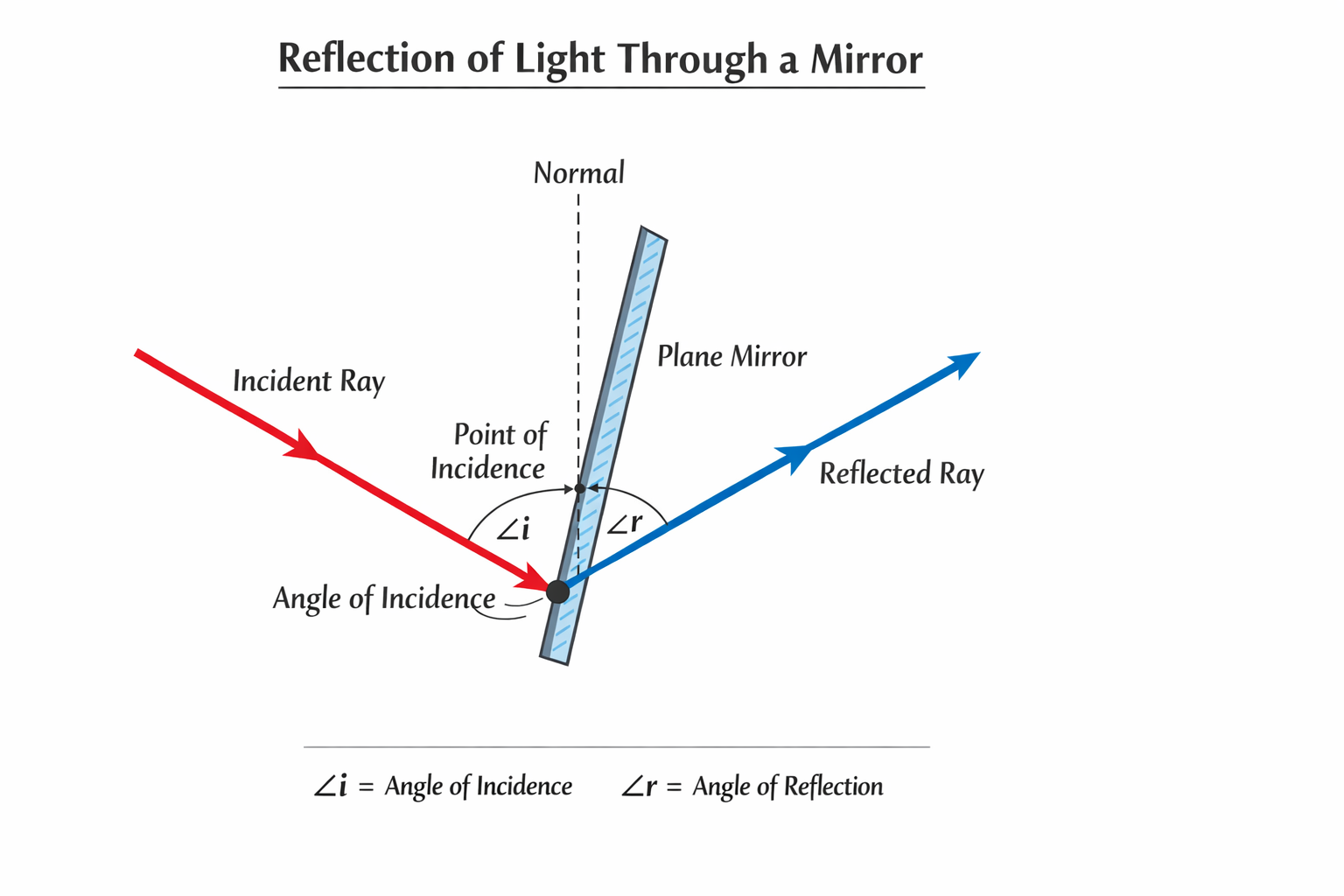
Reflection of Light
Key Terms (NCERT Language)
- Incident Ray: The ray of light which falls on the surface
- Reflected Ray: The ray that comes back
- Normal: Perpendicular line at point of incidence
- Angle of Incidence (i): Angle between incident ray and normal
- Angle of Reflection (r): Angle between reflected ray and normal
Laws of Reflection (NCERT Line-by-Line)
- The angle of incidence is equal to the angle of reflection
- The incident ray, reflected ray and normal lie in the same plane
Types of Reflection (NCERT)
Regular Reflection
- Occurs on smooth surface
- Parallel rays remain parallel
- Forms clear image
Diffused Reflection
- Occurs on rough surface
- Rays scatter in different directions
- No clear image formed
Spherical Mirrors (NCERT)
A spherical mirror is a mirror whose reflecting surface is a part of a hollow sphere. These mirrors are of two types: concave mirror and convex mirror.
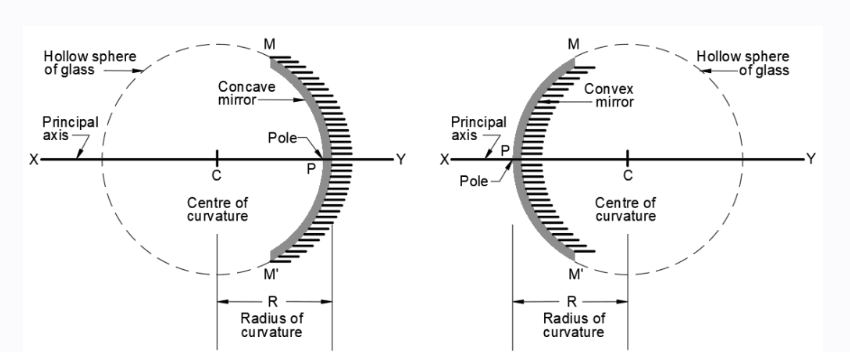
Spherical Mirrors
Concave Mirror (NCERT Deep)
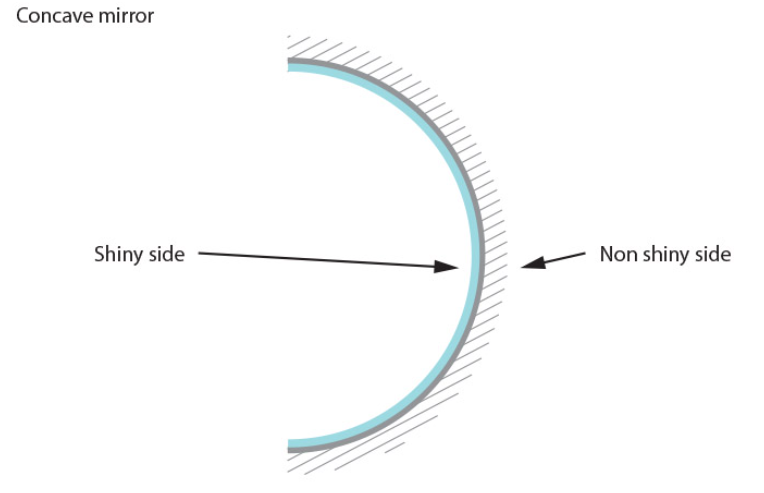
- Reflecting surface curves inward
- Parallel rays converge at focus
- Forms real and inverted image (generally)
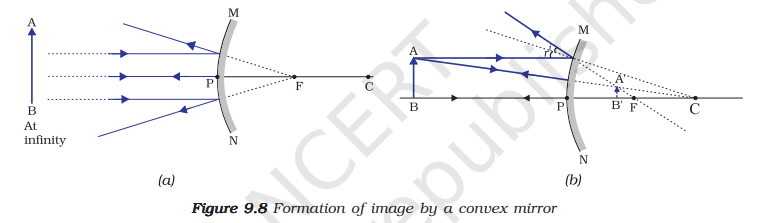
Convex Mirror (NCERT Deep)
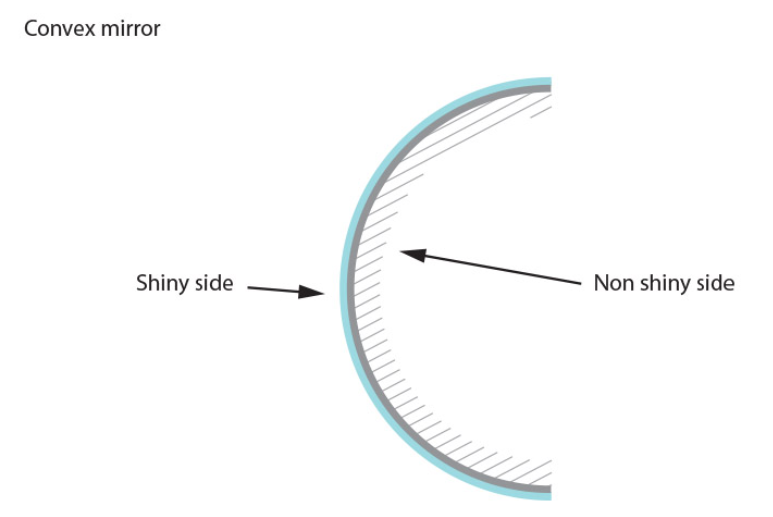
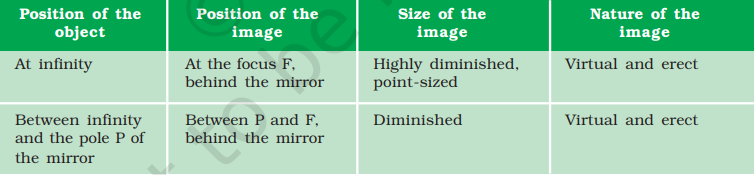
- Reflecting surface bulges outward
- Parallel rays diverge
- Forms virtual and erect image
Important Terms of Spherical Mirror
- Pole (P): Center of mirror
- Center of Curvature (C): Center of sphere
- Radius of Curvature (R): Distance PC
- Focus (F): Point where rays meet
- Principal Axis: Line joining P and C
Ray Diagram Rules (NCERT)
- Ray parallel to axis → passes through focus
- Ray through focus → becomes parallel
- Ray through center → reflects back
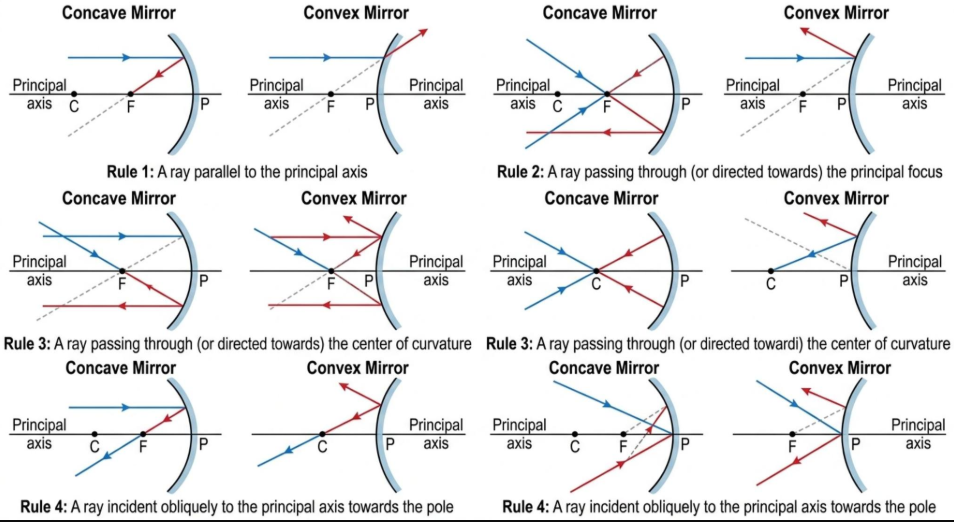
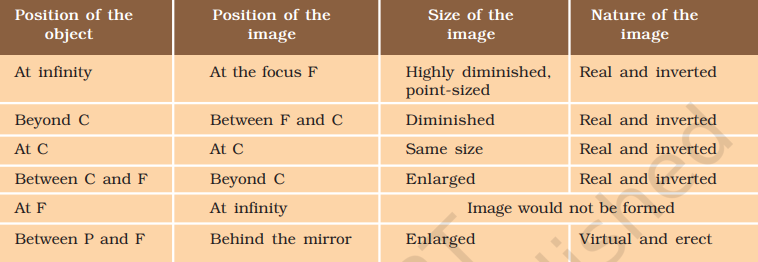
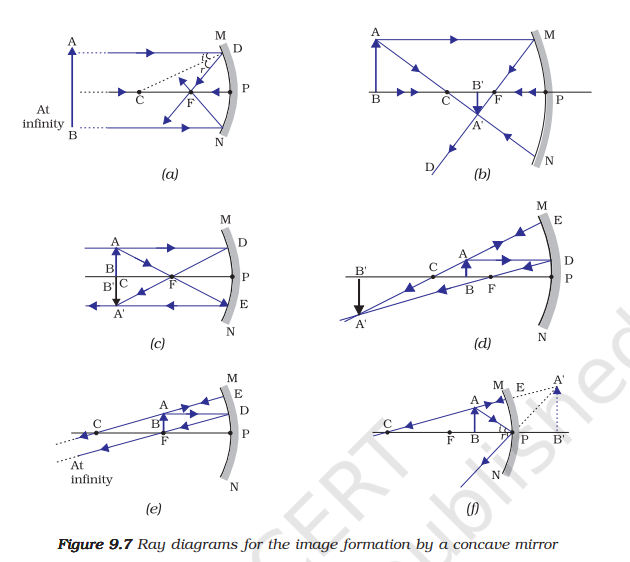
Image Formation by Concave Mirror (NCERT Table Logic)
- (a) Object at infinity → image at F
- (b) Object beyond C → image between C and F
- (c) Object at C → image at C
- (d) Object between C and F → image beyond C
- (e) Object at F → image at infinity
- (f) Object between F and P → virtual image
Sign Convention (NCERT Rules)
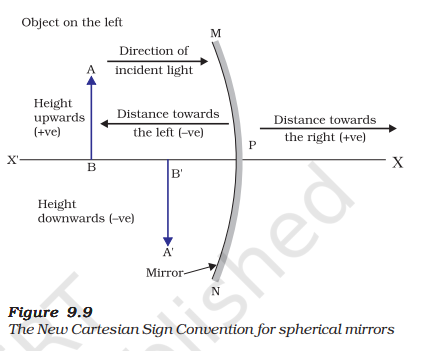
- Distances measured from pole
- Direction of incident light → positive
- Opposite direction → negative
- Height above axis → positive
- Height below axis → negative
Mirror Formula (NCERT Derivation Result)
Magnification (NCERT)
- m positive → erect image
- m negative → inverted image
Important NCERT Points
- Reflection follows laws
- Concave mirror converges
- Convex mirror diverges
- R = 2f relation
- Sign convention must follow
Refraction of Light (NCERT Deep Explanation)
When light passes from one transparent medium to another, its speed changes due to difference in optical density. This change in speed causes the light to bend at the boundary of two media. This bending of light is called refraction.

Refraction of Light
Observation (NCERT)
When a pencil is partially immersed in water, it appears bent at the surface. This is due to refraction of light as light changes its direction when passing from water to air.
- Object appears displaced
- Light bends at boundary
Cause of Refraction (NCERT)
- Change in speed of light
- Different optical densities of media
Refraction Rules (NCERT Ray Behavior)
- Light bends towards normal when entering denser medium
- Light bends away from normal when entering rarer medium
Laws of Refraction (Snell’s Law)
- The incident ray, refracted ray and normal lie in same plane
- The ratio of sin i to sin r is constant
Refractive Index (NCERT Definition)
Refractive index of a medium is defined as the ratio of speed of light in vacuum to the speed of light in that medium.
- c = speed of light in vacuum
- v = speed of light in medium
Optical Density (Concept)
- Denser medium → higher refractive index
- Rarer medium → lower refractive index
Refraction Through Glass Slab (NCERT)
When light passes through a rectangular glass slab, it bends at both surfaces. However, the emergent ray becomes parallel to the incident ray.

Refraction Through Glass Slab
- Two refractions occur
- Lateral displacement observed
Lateral Displacement
The perpendicular distance between the emergent ray and the incident ray is called lateral displacement.
- Depends on thickness
- Depends on refractive index
Real Depth vs Apparent Depth
Objects under water appear closer than they actually are. This is because light bends away from normal when coming from water to air.
- Real depth > apparent depth
Refraction by Spherical Lenses (NCERT)
A lens is a transparent medium bounded by two surfaces, at least one of which is spherical. Lenses form images by refraction.

Types of Lenses
Types of Lenses
Convex Lens
- Converges parallel rays
- Forms real image
Concave Lens
- Diverges rays
- Forms virtual image
Important Terms of Lens
- Optical center (O)
- Principal axis
- Focus (F)
- Focal length (f)
Ray Diagram Rules (Lens)
- Ray parallel → passes through focus
- Ray through focus → becomes parallel
- Ray through optical center → no deviation
Lens Formula (NCERT Result)
Magnification (Lens)
- m positive → erect image
- m negative → inverted image
Power of Lens (NCERT)
- Unit = dioptre (D)
- Convex lens → positive power
- Concave lens → negative power
Important NCERT Points
- Refraction due to speed change
- Snell’s law important
- Lens formula important
- Power relation important
Sign Convention (NCERT Deep Rules)
In ray optics, sign convention is used to assign positive and negative values to distances and heights. This is essential for solving numerical problems correctly.
- All distances are measured from pole (mirror) or optical center (lens)
- Distances measured in direction of incident light → positive
- Distances opposite to incident light → negative
- Height above principal axis → positive
- Height below principal axis → negative
Mirror Formula (Derivation Concept)
The mirror formula relates object distance (u), image distance (v), and focal length (f) of a spherical mirror. It is derived using geometry of similar triangles formed in ray diagrams.
- Used for all spherical mirrors
- Works with sign convention
Magnification (Mirror)
Magnification is defined as the ratio of height of image to height of object.
- m positive → erect image
- m negative → inverted image
- |m| > 1 → enlarged image
- |m| < 1 → diminished image
Numerical Example (Mirror)
Question: A concave mirror has focal length = -10 cm. Object is placed at -20 cm. Find image distance.
Solution:
- f = -10 cm
- u = -20 cm
Solving:
Result: Image formed at -20 cm (real image)
---Refraction Formula (Derivation Idea)
Refraction formula is derived from Snell’s law and geometry of refraction at spherical surfaces. It relates object distance, image distance, and focal length of lens.
Magnification (Lens)
- m positive → virtual image
- m negative → real image
Numerical Example (Lens)
Question: A convex lens has focal length 10 cm. Object placed at -15 cm. Find image distance.
- f = +10 cm
- u = -15 cm
Solving:
Result: Image at 30 cm (real image)
---Power of Lens (Deep Concept)
Power of a lens measures its ability to converge or diverge light. It is defined as the reciprocal of focal length in meters.
- Unit = dioptre (D)
- Convex lens → positive power
- Concave lens → negative power
Combination of Lenses
When two lenses are placed close together, their total power is the sum of individual powers.
Important NCERT Numerical Tips
- Always convert units properly
- Use correct sign convention
- Write formula first
- Substitute values carefully
- Show steps for marks
Common Mistakes (Avoid)
- Wrong sign convention
- Mixing mirror and lens formula
- Not writing units
- Calculation errors
Important NCERT Points
- Mirror formula works for all mirrors
- Lens formula works for all lenses
- Magnification tells image size
- Power shows strength of lens
NCERT Line-by-Line Revision
Light is a form of energy that enables us to see objects. It travels in straight lines in a homogeneous medium. When light strikes a surface, it can be reflected or refracted depending on the nature of the surface and medium.
Reflection follows two laws: the angle of incidence is equal to the angle of reflection, and all rays lie in the same plane. Refraction occurs when light passes from one medium to another and bends due to change in speed.
Spherical mirrors and lenses form images according to certain rules. These images can be real or virtual, erect or inverted, depending on object position.
Detailed Definitions (50 Words Each)
Reflection of Light
Reflection of light is the process in which light rays bounce back after striking a surface. It obeys the laws of reflection and is responsible for image formation in mirrors.
Refraction of Light
Refraction of light is the bending of light when it travels from one medium to another due to change in speed. It obeys Snell’s law and is responsible for image formation in lenses.
Refractive Index
Refractive index is defined as the ratio of speed of light in vacuum to its speed in a medium. It determines how much light bends when entering the medium.
Power of Lens
Power of a lens is the reciprocal of its focal length in meters. It indicates the ability of a lens to converge or diverge light and is measured in dioptres.
---Case Based Questions
Case 1
A ray of light falls on a mirror and reflects back with same angle.
- Which law is applied?
- What is relation between i and r?
Case 2
A coin placed in water appears raised.
- Which phenomenon occurs?
- Why does it happen?
Assertion Reason Questions
Q1: Assertion: Light bends in water. Reason: Speed of light changes in water.
Q2: Assertion: Convex mirror forms virtual image. Reason: It diverges light rays.
Very Important Questions
- Define laws of reflection
- Explain refraction with diagram
- Derive mirror formula
- Write lens formula
- Define power of lens
Topper Notes (Must Learn 💯)
- Mirror formula → 1/f = 1/v + 1/u
- Lens formula → 1/f = 1/v - 1/u
- Magnification mirror → -v/u
- Magnification lens → v/u
- Power → 1/f
Common Mistakes (Avoid)
- Mixing mirror and lens formula
- Wrong sign convention
- Skipping units
- Not drawing ray diagrams
Real Life Applications
- Rear view mirror → convex mirror
- Shaving mirror → concave mirror
- Magnifying glass → convex lens
- Spectacles → concave lens
Important NCERT Points
- Light travels straight
- Reflection obeys laws
- Refraction depends on medium
- Lens forms images
- Power measures lens strength
Detailed SEO Content (Google Ranking Booster 🔥)
The chapter "Light – Reflection and Refraction" is one of the most important topics in CBSE Class 10 Science. It explains how light behaves when it interacts with surfaces and different media. This chapter covers concepts such as reflection, refraction, spherical mirrors, lenses, and optical instruments.
Reflection of light is the bouncing back of light rays from a surface. It follows two important laws: the angle of incidence is equal to the angle of reflection, and all rays lie in the same plane. Reflection is used in mirrors to form images.
Refraction of light is the bending of light when it passes from one medium to another due to change in speed. This phenomenon explains why objects appear bent in water. The refractive index determines how much light bends in a medium.
Spherical mirrors and lenses are important optical devices. Concave mirrors converge light rays, while convex mirrors diverge them. Similarly, convex lenses converge light and concave lenses diverge light. These devices are widely used in daily life.
Students must understand formulas like mirror formula, lens formula, and power of lens to solve numerical problems. Practicing ray diagrams and numericals is essential to score high marks in board exams.
Topper Revision Sheet 🚀
- Reflection → bounce of light
- Refraction → bending of light
- Mirror formula → 1/f = 1/v + 1/u
- Lens formula → 1/f = 1/v - 1/u
- Magnification → -v/u (mirror), v/u (lens)
- Power → 1/f
Formula Revision (Very Important)
- 1/f = 1/v + 1/u
- 1/f = 1/v - 1/u
- m = -v/u
- m = v/u
- P = 1/f
Diagram Practice List
- Reflection diagram
- Ray diagram of concave mirror
- Ray diagram of convex mirror
- Refraction through glass slab
- Convex lens ray diagram
- Concave lens ray diagram
Explore More Chapters
--- ---Final Power Revision 💯
- Light travels straight
- Reflection obeys laws
- Refraction depends on medium
- Convex lens converges
- Concave lens diverges
- Numericals important