Introduction to Heredity
Heredity is the process by which characteristics are passed from parents to their offspring. These characteristics, also known as traits, are controlled by genes. Heredity ensures continuity of species by transferring genetic information from one generation to another.
Every organism inherits features from its parents, such as eye color, height, and shape. These inherited features help us understand how organisms are similar yet different.
- Ensures continuity of life
- Transfers genetic information
- Controlled by genes
Variation (Detailed)
Variation refers to the differences in characteristics among individuals of the same species. These differences may be small or large and can be observed in traits like height, color, shape, and behavior.
- No two individuals are exactly identical
- Variation is common in all organisms
- Variation helps survival in changing environment
Types of Variation
1. Inherited Variation
- Passed from parents to offspring
- Controlled by genes
2. Acquired Variation
- Developed during lifetime
- Not inherited
Gregor Mendel and His Work
Gregor Mendel is known as the father of genetics. He performed experiments on pea plants to study how traits are inherited. His work laid the foundation of modern genetics.
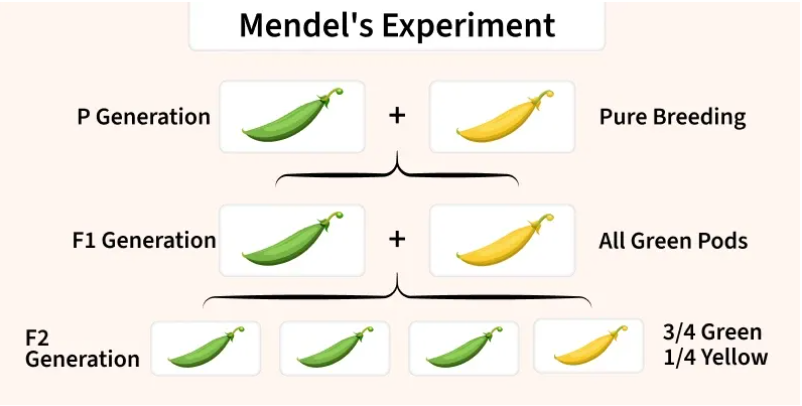
Mendel’s Pea Plant Experiment
- Used pea plants for experiments
- Studied traits like height and color
- Worked on inheritance patterns
Why Mendel Chose Pea Plants
- Easy to grow
- Short life cycle
- Clear visible traits
- Can self-pollinate and cross-pollinate
Monohybrid Cross
A monohybrid cross is a cross between two individuals differing in a single trait.
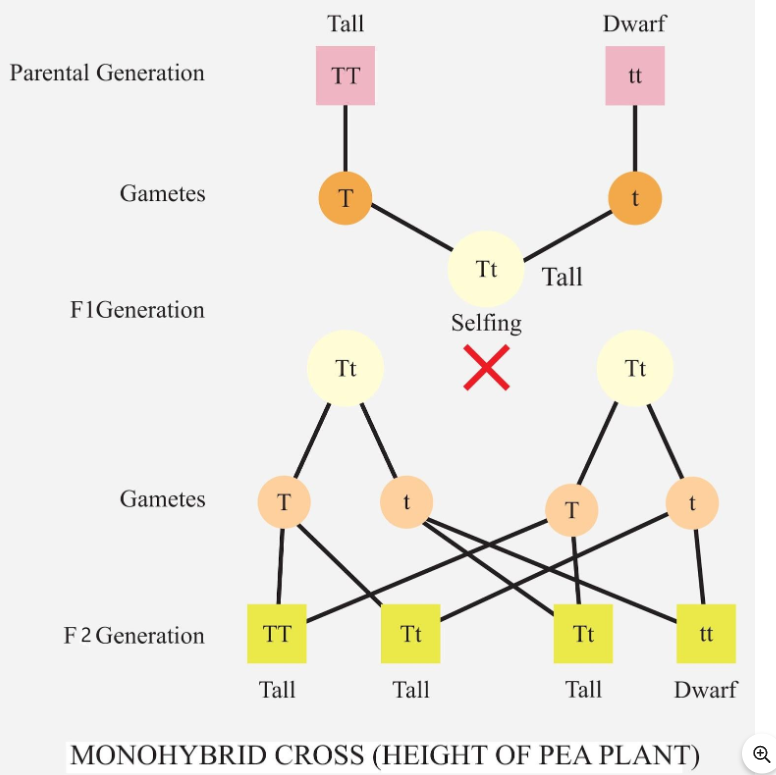
Monohybrid Cross
- Example: Tall plant × Short plant
- F1 generation shows dominant trait
- F2 generation shows 3:1 ratio
Dominant and Recessive Traits
Traits are of two types: dominant and recessive. Dominant traits are expressed in offspring, while recessive traits are hidden in the presence of dominant traits.
- Dominant trait → visible
- Recessive trait → hidden
Law of Dominance
This law states that when two contrasting traits are present, only one trait (dominant) is expressed while the other (recessive) remains hidden.
---Law of Segregation
According to this law, allele pairs separate during gamete formation so that each gamete carries only one allele.
Genotype and Phenotype
- Genotype: Genetic makeup (TT, Tt, tt)
- Phenotype: Physical appearance (Tall, Short)
Punnett Square
Punnett square is a diagram used to predict the genetic outcome of a cross.
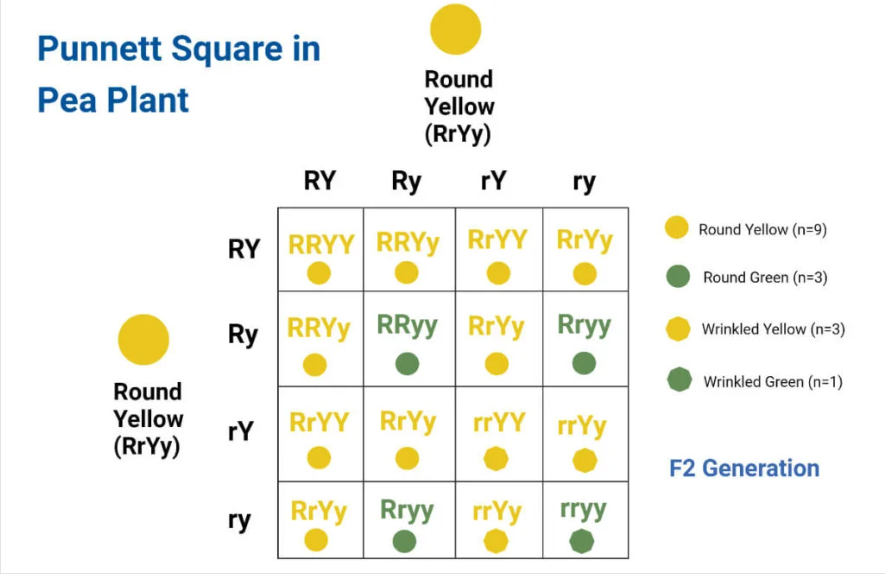
Punnett Square
- Shows possible combinations
- Helps in predicting traits
Important NCERT Points
- Traits are controlled by genes
- Genes are present on chromosomes
- Mendel explained inheritance patterns
- Dominant traits are expressed
Dihybrid Cross
A dihybrid cross is a genetic cross between individuals involving two pairs of contrasting traits. It helps in studying the inheritance of two different characteristics at the same time.
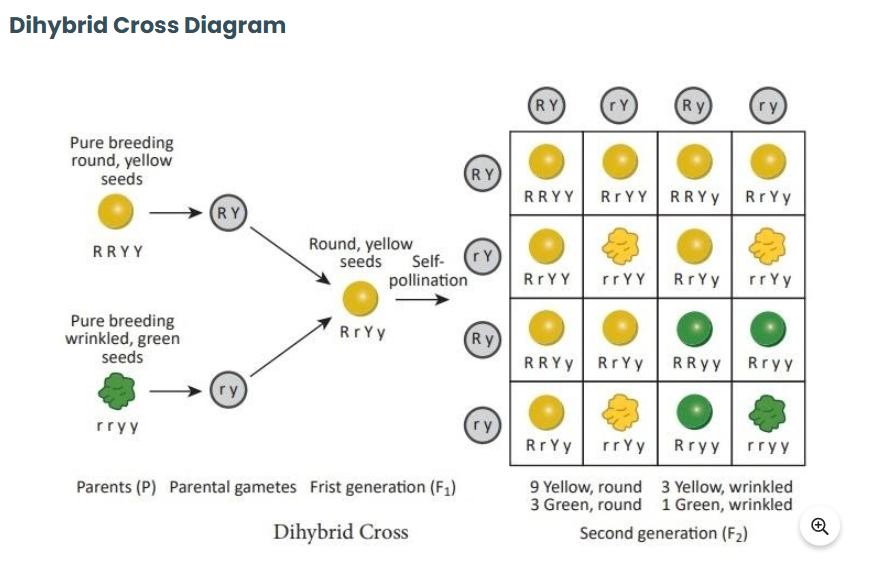
Dihybrid Cross
- Involves two traits
- Example: seed shape and seed color
- F2 generation ratio = 9:3:3:1
Law of Independent Assortment
This law states that different pairs of alleles are inherited independently of each other. The inheritance of one trait does not affect the inheritance of another trait.
Chromosomes (Detailed)
Chromosomes are thread-like structures present in the nucleus of cells. They carry genes and are responsible for the transmission of hereditary information.
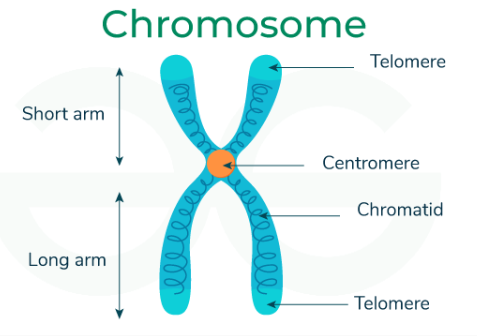
Chromosome Structure
- Made of DNA
- Carry genetic information
- Present in pairs
Genes (Deep Explanation)
Genes are segments of DNA that control specific traits. They are located on chromosomes and determine characteristics such as height, color, and shape.
- Unit of heredity
- Present in pairs (alleles)
- Control traits
Alleles
Alleles are different forms of a gene that control a particular trait. One allele is inherited from each parent.
- Dominant allele
- Recessive allele
Inheritance of Traits
Traits are inherited from parents through genes. Each parent contributes one allele, and the combination determines the trait in offspring.
Inheritance using Punnett Square
- Combination of alleles
- Determines phenotype
Sex Determination in Humans
Sex determination is the process by which the sex of an offspring is decided. In humans, it is controlled by sex chromosomes.
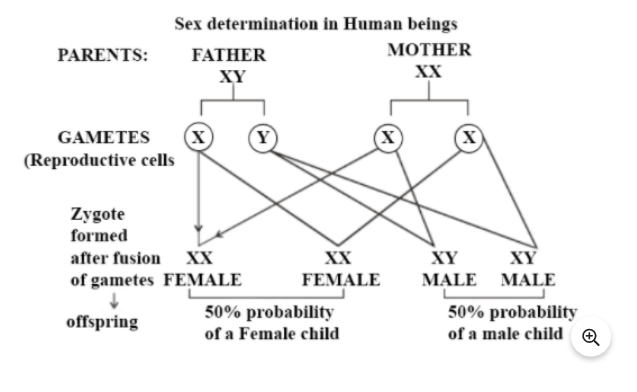
Sex Determination
- Female = XX
- Male = XY
How Sex is Determined
- Mother gives X chromosome
- Father gives X or Y chromosome
- X + X → Female
- X + Y → Male
Important NCERT Concepts
- Genes are carried on chromosomes
- Traits are inherited
- Sex is determined by chromosomes
- Alleles occur in pairs
Case Based Questions
Case 1
A plant shows two traits: tall height and green color.
- What type of cross is used?
- What ratio is expected?
Case 2
A child is born male. Which chromosome combination is present?
- Answer: XY
Assertion Reason Questions
Q1: Assertion: Chromosomes carry genes. Reason: Genes are made of DNA.
Q2: Assertion: Father determines sex of child. Reason: Father contributes X or Y chromosome.
Final Quick Revision
- Dihybrid ratio = 9:3:3:1
- Gene = unit of heredity
- Chromosomes carry genes
- Sex determined by XY system
NCERT Line-by-Line Concepts
In living organisms, heredity is responsible for maintaining similarities between parents and offspring, while variation introduces differences. These variations may be beneficial for survival in changing environmental conditions.
Genes located on chromosomes carry hereditary information. During reproduction, DNA copying takes place, which leads to inheritance of traits. Small changes during DNA copying result in variation.
Detailed Definitions (50 Words Each)
Heredity
Heredity is the process by which traits and characteristics are passed from parents to their offspring through genes. It ensures continuity of species and helps in maintaining similarities among individuals of the same species across generations.
Gene
A gene is the basic unit of heredity that controls specific traits in an organism. It is a segment of DNA located on chromosomes and carries genetic information from parents to offspring.
Chromosome
Chromosomes are thread-like structures present in the nucleus of cells. They are made up of DNA and proteins and carry genes that control hereditary traits and pass them from one generation to another.
Variation
Variation refers to the differences in traits among individuals of the same species. It may arise due to genetic differences or environmental factors and plays an important role in survival and adaptation.
---Very Important NCERT Points
- Genes control traits
- Chromosomes carry genes
- DNA copying causes variation
- Mendel explained inheritance patterns
- Sex is determined by chromosomes
Topper Notes (Must Learn 🔥)
- Monohybrid ratio = 3:1
- Dihybrid ratio = 9:3:3:1
- Gene = unit of heredity
- Alleles = forms of gene
- Father determines sex
Common Mistakes (Avoid in Exam)
- Do not confuse genotype and phenotype
- Write correct ratios (3:1 and 9:3:3:1)
- Do not mix dominant and recessive traits
- Label diagrams properly
Case Based Questions
Case 1
Two plants are crossed and produce offspring in ratio 3:1.
- Which cross is this?
- What does it show?
Case 2
A child has XY chromosomes.
- What is the sex of child?
Assertion Reason Questions
Q1: Assertion: Genes are located on chromosomes. Reason: Chromosomes carry DNA.
Q2: Assertion: Variation is important. Reason: It helps in survival.
Extra Concept (High Level)
Genetic Stability
Heredity ensures genetic stability by passing traits from one generation to another. At the same time, small variations occur, which help organisms adapt to new environments.
Explore More Chapters
--- ---Final Power Revision 🚀
- Heredity = transfer of traits
- Gene = unit
- Chromosome = carrier
- Variation = survival
- Mendel = father of genetics
About chapter -- Heredity
The chapter "Heredity" in CBSE Class 10 Science explains how traits are passed from parents to offspring through genes. It is one of the most important chapters in biology as it forms the foundation of genetics. Understanding heredity helps students learn how characteristics like height, color, and shape are inherited.
Gregor Mendel, known as the father of genetics, conducted experiments on pea plants and discovered fundamental laws of inheritance. His work explains dominant and recessive traits, monohybrid and dihybrid crosses, and the concept of alleles. These concepts are essential for solving numerical and conceptual questions in exams.
Genes are segments of DNA present on chromosomes. They carry genetic information and determine traits. During reproduction, DNA copying occurs, and slight variations arise, which are essential for survival and adaptation.
The chapter also explains sex determination in humans, where the father determines the sex of the child based on X and Y chromosomes. Understanding this concept is very important for board exams and helps clear common misconceptions.
Overall, heredity is a scoring chapter in CBSE exams because it includes diagrams, definitions, and clear concepts. Students should focus on Punnett squares, Mendel's laws, and key definitions to score high marks.